The Real Cost of Commercial Fitness Equipment: A 10-Year TCO Breakdown for Buyers
Learn how to calculate the total cost of commercial gym equipment, including purchase price, installation, maintenance, repairs, energy, downtime, replacement cycles, and cycles, and long-term service
Most equipment RFQs die on price per unit. That’s the wrong fight. A $9,000 treadmill and a $5,000 “equivalent” import quote look like a no-brainer decision — until you run the 10-year numbers and find they land within a few thousand dollars of each other. This article breaks down what actually drives total cost across the six major commercial equipment categories, so you can stop comparing catalog prices and start comparing what you’ll actually spend.
What Total Cost of Ownership Actually Means in This Industry
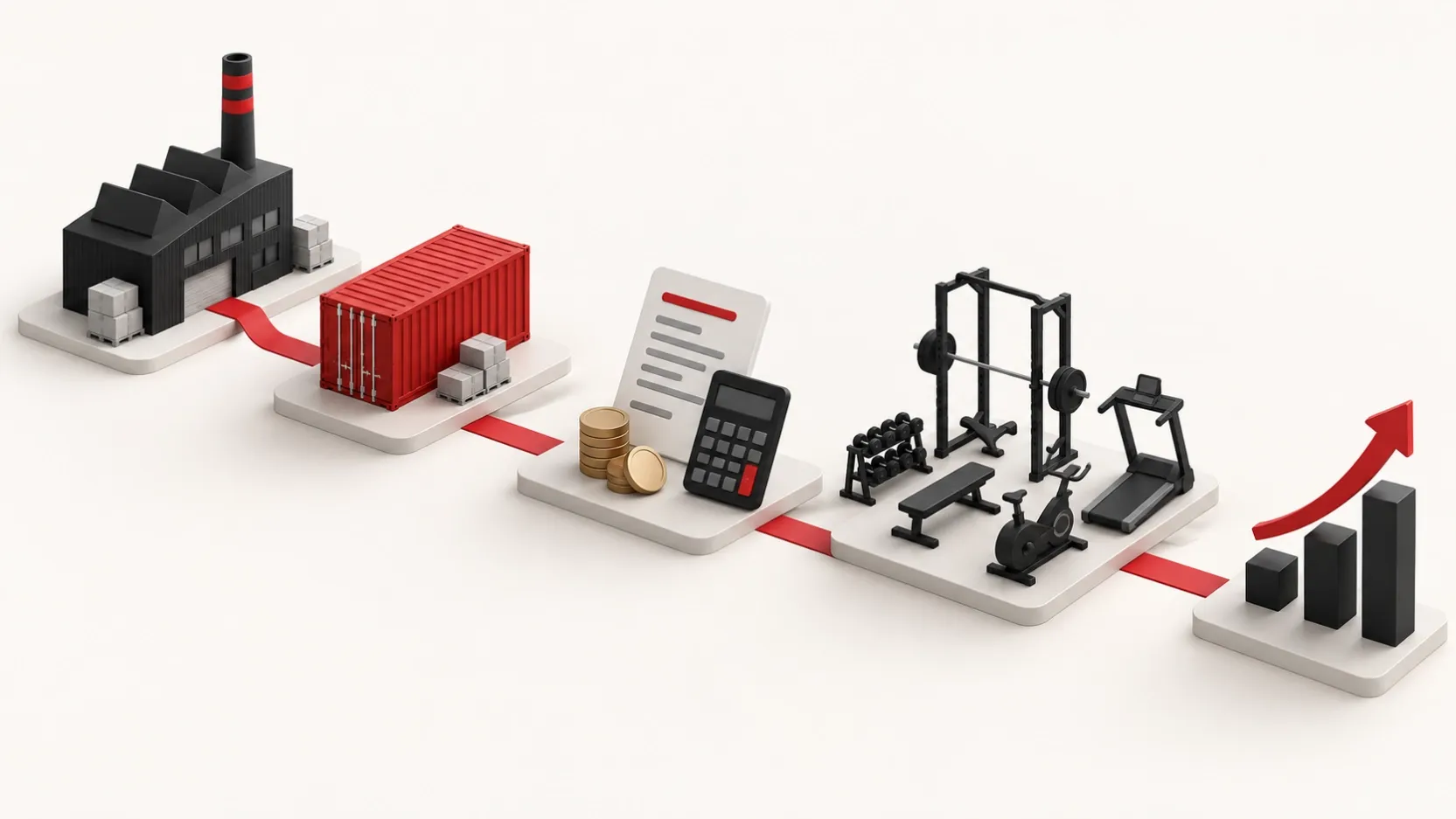
Total Cost of Ownership (TCO) refers to the sum of every dollar a piece of equipment consumes from purchase to replacement — not just the invoice price, but freight, duties, installation, preventive maintenance, repair labor, parts, software, energy, downtime, and eventual refresh cost. Most buyers price equipment on acquisition cost alone, which typically represents only 40–70% of what the asset will actually cost over a decade.
The data backs this up with real multiples. Commercial treadmills run 1.8–2.6x their purchase price over 10 years; ellipticals run 1.5–2.1x; pin-loaded strength machines run 1.3–1.8x; power racks run 1.2–1.5x; cable/functional trainers run 1.3–1.8x; and free weight areas run 1.2–1.6x [Precor, Life Fitness, Hamilton Home Fitness]. Translate that into dollars and a $9,000 treadmill becomes a roughly $30,900 asset over 10 years, while a $3,000 power rack becomes roughly $5,950 [industry TCO modeling based on published specs, warranty terms, and maintenance pricing]. The gap between “cheapest category to buy” and “cheapest category to own” is not the same ranking — and that’s the entire point of building a TCO model before you sign a PO.
This isn’t a fixed formula any manufacturer guarantees — it’s a budgeting framework built from public specs, warranty terms, maintenance schedules, electricity data, and service market pricing. It also deliberately excludes flooring, HVAC, rent, insurance, and staffing — those belong in a facility-level ROI model, not an equipment-level one.
Action tip: Before comparing any two quotes, convert both to a 10-year TCO estimate using purchase price × category multiplier. If a supplier can’t or won’t discuss maintenance ratios, service response times, or parts pricing, treat that silence as a red flag on the multiplier, not a discount.
Cardio Equipment Carries the Highest
Long-Term Risk**
Cardio equipment — primarily treadmills and ellipticals — refers to the category with the most moving parts, the most electronics, and the highest energy draw, which makes it the single largest driver of unplanned 10-year cost in most commercial facilities. A treadmill alone packs an AC motor, belt, deck, rollers, incline system, control board, touchscreen, and network connectivity into one unit — every one of which is a separate failure point [Life Fitness product specifications].
The numbers make the case. A mid-to-high-end commercial treadmill priced at $9,000 typically requires $1,800 in delivery and installation, $3,500 in preventive maintenance over 10 years, $4,500 in repair parts and labor, and $6,120 in electricity — even using a conservative 0.8 kW average load figure rather than motor nameplate wattage, at 2,800 hours of annual use and California’s commercial electricity rate of $0.2733/kWh [EIA, industry TCO modeling]. That brings a single treadmill to roughly $30,900 over a decade — more than triple its sticker price. Ellipticals fare somewhat better on energy (0.15 kW average load keeps 10-year electricity cost near $1,150) but still land around $20,000 in total cost against an $8,000 purchase price, driven mainly by roller, track, bearing, and drive-belt wear [Precor preventive maintenance guidelines].
Warranty coverage softens but doesn’t eliminate this exposure. A common commercial cardio warranty structure runs 7 years on frame and motor, 3 years on mechanical/electrical parts, 3 years on labor, and just 6 months on cosmetic components [Life Fitness warranty documentation]. That means the parts most likely to fail in years 4–10 — belts, decks, rollers, control boards, displays — are largely on the buyer’s dime once the parts warranty lapses, even if the motor and frame are still covered.
Action tip: Budget cardio maintenance and repair reserves at 7–12% of purchase price annually for treadmills and 5–9% for ellipticals [Hamilton Home Fitness, Ardent Fitness]. If your facility runs 24-hour access or high daily throughput, plan toward the top of that range — not the average.
Strength Equipment Has Longer Bones But
Real Recurring Costs**
Strength equipment — pin-loaded machines, power racks, cable trainers, and free weights — refers to the category built around welded steel structures that routinely outlast their electronic cardio counterparts, but that durability applies to the frame, not the wear components riding on it. Cables, pulleys, bearings, upholstery, grips, guide rods, weight-selector pins, and decals are consumable regardless of how solid the steel is [Precor, Hamilton Home Fitness].
The layered warranty structure on a typical dual-function pin-loaded machine illustrates this well: a 10-year frame warranty, 5-year warranty on pulleys/weight stacks/guide rods, just 1 year on bearings/cables/grips/electrical components, and 90 days on upholstery [Hammer Strength / Life Fitness product warranty page]. That tiering is basically a manufacturer’s own admission of where the real cost lives — not in the steel, but in everything that moves against the steel. Over 10 years, a $4,500 pin-loaded machine runs to roughly $11,000 in total cost, driven by $1,500 in repair parts/labor and $1,100 in refresh reserve for the 8–10 year mark [industry TCO modeling].
Power racks are the outlier in the best possible way. A commercial-grade rack built from 3×3-inch, 11-gauge steel can run 15+ years without structural failure, provided it’s properly anchored and not overloaded [Rogue Fitness]. A full working setup — rack plus safety arms, J-cups, pull-up bar, and storage — should be budgeted at $3,000+, not the base frame price alone, because component pricing pages quote bare frames starting around $1,520 without any of the accessories a commercial buyer actually needs [Rogue Fitness]. Even so, a rack’s 10-year TCO lands around $5,950 — by far the lowest multiplier of any category, at roughly 2x purchase price over a decade [industry TCO modeling]. Cable trainers sit between the two extremes: a single-tower unit priced around $3,095–$5,000 climbs to roughly $12,300 over 10 years, mostly from cable, pulley, and bearing wear on equipment that sees near-constant use [Rogue Fitness, Precor].
Repair market pricing confirms the risk profile. Commercial cable repair or diagnostic call-outs commonly run $99–$299 depending on region and complexity, before parts [The Equipment Fixer, FixFitness]. Any cable showing fraying, deformation, broken strands, or damaged end fittings should be pulled from service immediately rather than left until the next scheduled maintenance visit [Precor].
Action tip: Treat racks and cable towers differently in your capital plan. Racks can be a “buy once, refurbish forever” asset — budget 1–3% of purchase price annually. Cable trainers need active wear-part budgeting at 4–8% annually, closer to cardio than to racks [Hamilton Home Fitness].
Direct Import Sourcing Changes the Math
More Than Buyers Expect**
Direct import sourcing refers to buying commercial equipment on FOB terms from an overseas factory rather than through a domestic distributor, and it’s where TCO modeling exposes the biggest gap between what buyers expect to save and what they actually save. FOB price is not landed price, and landed price is not operational price.
I ran this comparison myself against a real supplier quote for a commercial treadmill: $5,000 FOB from a China-based manufacturer against a $9,000 domestic distributor price for a comparable spec. On paper that’s a 44% discount. Once I built in ocean freight and insurance (~$550 on a shared container allocation), a tariff reserve (~$900 at an 18% placeholder rate, since actual duty depends on HS classification and Section 301 exposure), customs clearance and port fees (~$450), inland trucking and appointment delivery (~$700), and indoor rigging plus installation (~$1,300), the pre-operational landed cost came to $8,900 — within $100 of the domestic price before the equipment had even been plugged in. Extend that out to a 10-year TCO with elevated maintenance and downtime reserves (because parts lead times and warranty execution are less predictable without local service infrastructure), and the direct-import total came to roughly $32,000 — higher than the domestic-sourced treadmill’s $30,900 [personal cost-model exercise based on published freight, customs, and installation benchmarks].
That doesn’t mean direct import is a bad strategy — it means it’s category-dependent. For simple, non-electronic products shipped at full-container volume — power racks, weight plates, dumbbells, storage systems, benches — buyers who can manage QC, packaging, customs, and spare parts logistics themselves can meaningfully undercut domestic pricing, because there’s no motor, control board, or touchscreen risk to insure against [industry sourcing analysis]. For anything with electronics — treadmills, connected consoles, motorized incline systems — the after-sales risk of importing without local service infrastructure usually eats the FOB savings within a few years of failures.
HS classification adds another layer buyers routinely underestimate. Fitness equipment generally falls under HS Chapter 95, often HS 9506.91, but the applicable duty rate depends on product design, material, function, country of origin, and current Section 301 exposure — not just the product category name [USITC, CBP Rulings]. A tariff assumption baked into a sourcing decision without a customs broker’s confirmation is a guess, not a number.
Action tip: Before committing to direct import on any electronic equipment category, get a landed-cost quote — not an FOB quote — and stress-test it against domestic pricing including installation. Reserve direct import for non-electronic, high-density categories where full-container volume actually moves the needle.
Your RFQ Should Force Suppliers to Quote
the Whole Lifecycle, Not Just the Box**
An effective RFQ refers to a procurement document that requires suppliers to itemize lifecycle costs separately rather than bundling everything into one number, because bundled quotes are how buyers end up surprised in year three. Government and large commercial fitness procurement already treats installation, assembly, and commissioning as distinct line items rather than assumed inclusions — your RFQ should do the same.
At minimum, every quote should separately itemize: trade terms (EXW/FOB/CIF/DDP) and who owns duty risk; HS code and country of origin; net/gross weight and container loading plan; freight, insurance, and customs fees; indoor rigging, assembly, and commissioning charges; electrical requirements and annual energy draw; component-level warranty terms (frame, motor, belt, board, display, cable, pulley, upholstery, labor — each separately, not as one blanket “warranty”); extended service pricing and SLA response times; 5- and 10-year parts availability commitments; common spare-part pricing; and software/subscription terms including what happens to data access after contract termination.
On the operating budget side, annual maintenance and repair reserves should be set as a percentage of original purchase price: 7–12% for treadmills, 5–9% for ellipticals, 3–6% for pin-loaded strength, 1–3% for racks, 4–8% for cable trainers, and 2–5% for free weight areas. High-utilization facilities — 24-hour gyms, high-volume clubs, group training studios — should budget toward the top of each range; low-utilization settings like boutique hotel gyms or small corporate fitness rooms can plan closer to the bottom.
Replacement planning follows a similar logic but on a longer horizon: treadmills at 7–10 years, ellipticals at 8–12, pin-loaded strength at 10–15+, racks at 15+, cable trainers at 10–15, and free weights on a rolling annual restock rather than one-time replacement. The decision to replace versus repair should be driven by failure frequency on cardio (where electronics degrade the value proposition of continued repair) and by cosmetic/wear-part condition on strength equipment (where the frame usually still has years left).
Action tip: Build a standard RFQ template with every line item above as a mandatory field, not an optional one. Suppliers who leave fields blank or refuse to itemize are telling you something about post-sale support — listen to that signal before you sign.
FAQ
Q: Is the cheapest equipment on the invoice always the most expensive to own?
A: Not always, but it’s common enough that you should assume it until proven otherwise. The category multipliers show treadmills can run 1.8–2.6x their purchase price over 10 years, while power racks run closer to 2x from a much lower base — so low sticker price with high category multiplier is the combination that usually surprises buyers
Q: How much should I budget annually for maintenance if I don’t have a TCO model yet?
A: Use purchase price as your baseline and apply category-specific percentages: 7–12% for treadmills, 5–9% for ellipticals, 3–6% for pin-loaded strength machines, 1–3% for power racks, 4–8% for cable trainers, and 2–5% for free weight areas
Q: Does direct importing from overseas manufacturers actually save money?
A: It depends heavily on the equipment category. For non-electronic, high-density products like racks, plates, and dumbbells bought at full-container volume, it often does. For electronics-heavy equipment like treadmills with motors and control boards, landed cost plus elevated maintenance/downtime risk frequently closes most or all of the gap with domestic distributor pricing
Q: What’s the biggest cost blind spot buyers miss in RFQs?
A: Component-level warranty gaps. A blanket “7-year warranty” headline often hides the fact that cables, bearings, and upholstery may only be covered for 1 year or 90 days — meaning the parts most likely to fail are the ones with the shortest coverage
Q: How long does commercial fitness equipment actually last?
A: Roughly 7–12 years for treadmills, 8–12 for ellipticals, 10–15+ for strength machines, and 15+ for power racks — but actual lifespan depends heavily on daily usage hours, maintenance quality, humidity/sweat exposure, and parts availability
Q: Do connected/networked cardio machines always come with subscription fees?
A: Not necessarily — some manufacturer digital ecosystems are offered without additional subscription cost on compatible hardware, but third-party content platforms, entertainment streaming, cellular connectivity, and remote monitoring services often carry separate ongoing fees. Get software costs itemized separately in every quote rather than assuming they’re bundled or free
Plan Your Commercial Gym Equipment Project
Looking for commercial-grade strength, cardio, free-weight, or functional training equipment? Discuss your facility requirements with ZOYI FITNESS.
Get a Commercial Quote